
# How much does a smart home cost? Three Voldeno installation variants with modules and prices
"How much does a smart home cost?" The honest answer: it depends. In Voldeno it depends specifically on how many circuits you want to control. Every controlled function (a lighting circuit, a blind, a heating zone, a gate) maps to a specific input or output on a module. The total module count is your hardware cost. Below are three ready-made breakdowns: apartment ~100 m², house with garden ~120 m², and large house ~200 m²+.
# What makes up the cost of a Voldeno installation?
Every installation requires at least one Hub and as many functional modules as the number of controlled circuits demands:
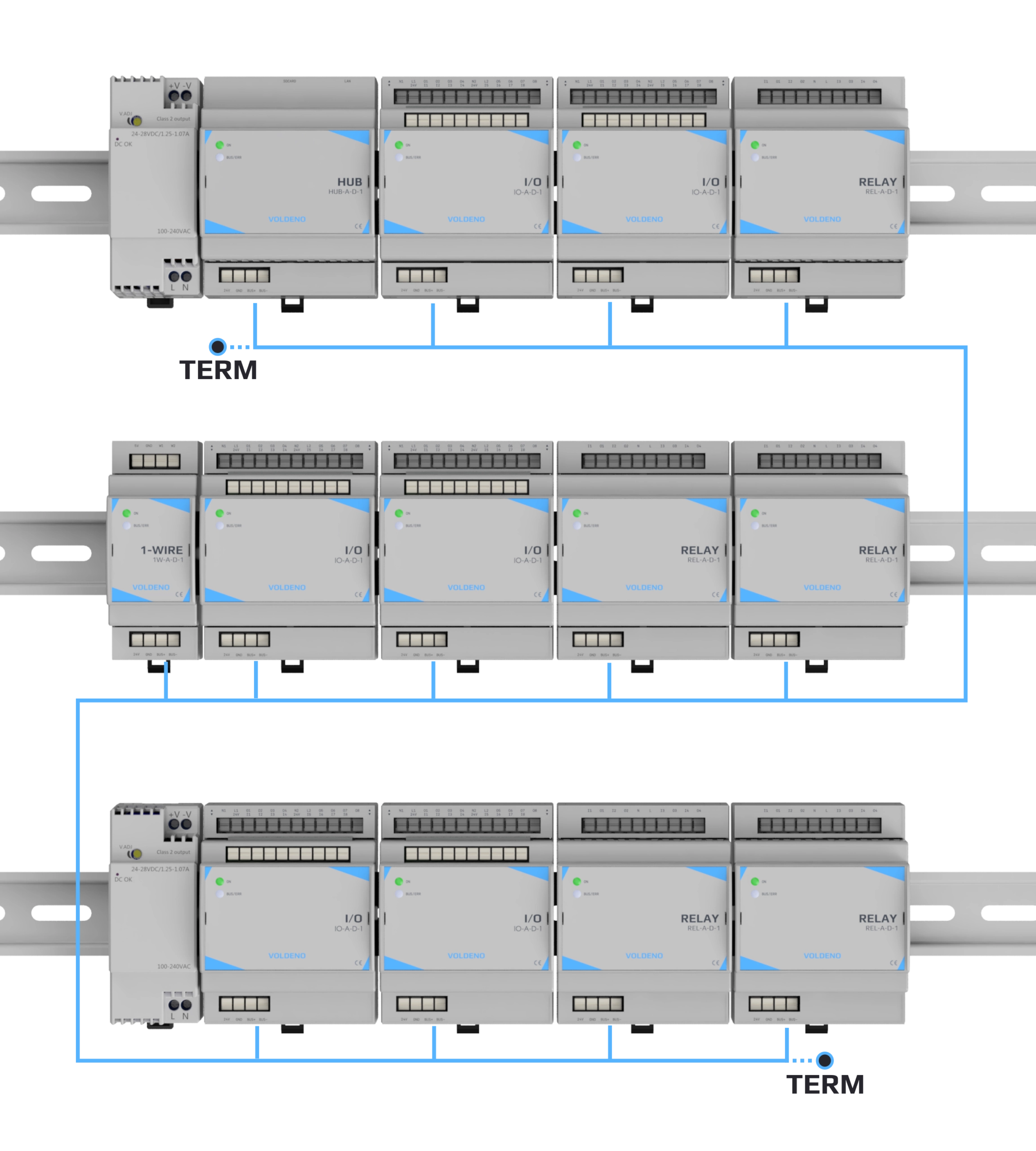
| Module | Price | What it does |
|---|---|---|
| Voldeno Hub | 1,299 PLN | System controller, local logic, HTTP/TCP, alarm integrations |
| I/O Module | 899 PLN | 8 inputs + 8 low-current outputs; wall switches, gates, irrigation, heating zone valve actuators, single lighting points with low inrush current |
| Relay Module | 599 PLN | 4 relay outputs 230 V; grouped lighting and LEDs with high inrush current, blinds, shutters, sockets, electric heating |
| 1-Wire Module | 599 PLN | Temperature measurement - 2 × 1-Wire buses, up to 20 DS18B20 temperature sensors per bus (40 total) |
| Analog Input Module | 599 PLN | 4 voltage inputs 0-10 V + 4 current inputs 0/4-20 mA; humidity, CO2, liquid level, and flow transducers |
I/O outputs are low-current: they drive solenoid valves, gate actuators, heating zone thermostatic heads, and single lighting points with a gentle inrush profile. Wherever contact durability matters under higher continuous or inrush currents (grouped lighting, LED fixtures with external drivers, blinds, sockets, electric heating), a Relay module is required. The Analog Input module is useful wherever transducer signals feed into the system: humidity, CO2, liquid level, or flow sensors on standard 0-10 V or 4-20 mA signals.
Full module descriptions: I/O, Relay, 1-Wire, Hub, Analog Input.
# Variant 1: Apartment ~100 m²
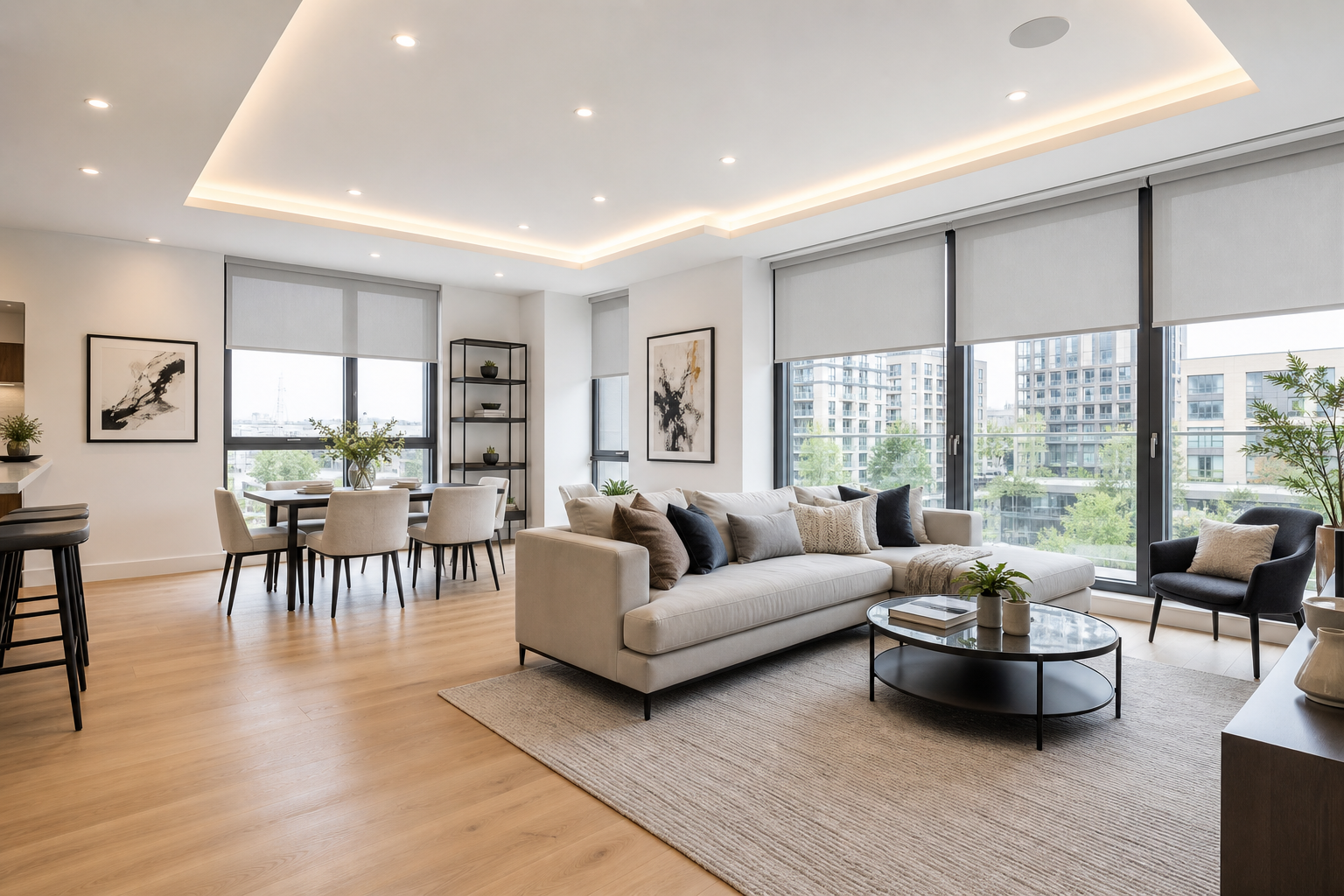
A typical 3-4 room apartment: living room, bedroom, children's room, kitchen, bathroom, WC. No garden, no gate.
Installation scope:
| Function | Count |
|---|---|
| Grouped / high-inrush lighting circuits (Relay) | 8 |
| Single low-current lighting points (I/O) | 4 |
| Blinds / shutters | 4 units - 2 Relay modules (2 blinds per module, up/down) |
| Heating zones | 4 - thermostatic heads on I/O outputs |
| Controlled sockets | 4 |
| 1-Wire temperature measurements | 4 |
| Wall switch keys | 12 I/O inputs |
Module configuration:
| Module | Qty | Cost |
|---|---|---|
| Voldeno Hub | 1 | 1,299 PLN |
| I/O Module | 2 | 1,798 PLN |
| Relay Module | 5 | 2,995 PLN |
| 1-Wire Module | 1 | 599 PLN |
| Total | 9 modules | 6,691 PLN |
How the 5 Relay modules are split: 2 modules for 8 lighting circuits, 2 modules for 4 blinds (each module drives 2 blinds: 4 outputs up/down), 1 module for 4 controlled sockets.
Port reserve: after this configuration, 4 I/O inputs remain free (e.g. for extra buttons at the bedside or in a wardrobe) along with 8 free I/O outputs. Free outputs can also be used with external DIN-rail relays: each I/O output drives one relay that switches a 230 V circuit. An external DIN relay costs around 30-40 PLN, so for larger numbers of circuits this approach can reduce the Relay module count and lower hardware cost. The trade-off: the I/O module does not measure current on its outputs, so you have no visibility into energy consumption of the controlled device, unlike a direct Relay output.
# Variant 2: House with garden ~120 m²
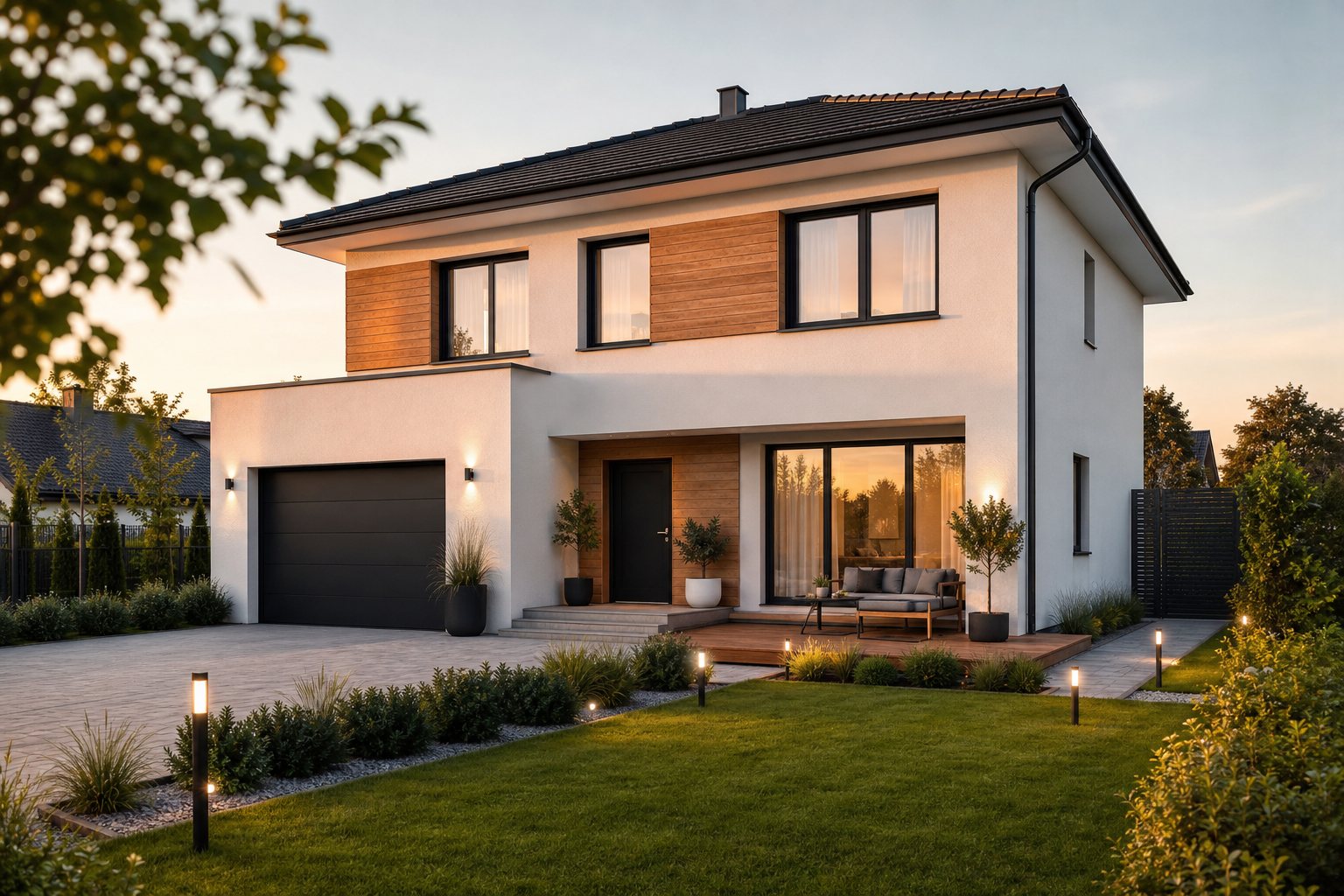
A 4-5 room house with garage, terrace, and garden. Heat pump with zone-by-zone circuit control, garage gate, pedestrian gate, 4 irrigation zones.
Installation scope:
| Function | Count |
|---|---|
| Grouped / high-inrush lighting circuits (Relay) | 12 |
| Single low-current lighting points (I/O) | 4 |
| Blinds / shutters | 8 units - 4 Relay modules (2 blinds per module, up/down) |
| Heating zones | 6 - thermostatic heads on I/O outputs |
| Controlled sockets | 6 |
| 1-Wire temperature measurements | 7 (6 indoor + 1 outdoor) |
| Gates and pedestrian gates | 3 (2 gates + 1 pedestrian) - I/O outputs |
| Garden irrigation | 4 zones - solenoid valves on I/O outputs |
| Wall switch keys | 20 I/O inputs |
| Analog sensors | 4 units: humidity in bathroom and utility room (0-10 V), CO2 in living room (0-10 V), rain or soil moisture sensor (0-10 V) |
Module configuration:
| Module | Qty | Cost |
|---|---|---|
| Voldeno Hub | 1 | 1,299 PLN |
| I/O Module | 3 | 2,697 PLN |
| Relay Module | 9 | 5,391 PLN |
| 1-Wire Module | 1 | 599 PLN |
| Analog Input Module | 1 | 599 PLN |
| Total | 15 modules | 10,585 PLN |
Split of 9 Relay modules: 3 for 12 lighting circuits, 4 for 8 blinds (each module drives 2 blinds: 4 outputs up/down), 2 for 6 sockets.
Three I/O modules handle: inputs from 20 wall switches, outputs to 6 heating zones, 3 gates/pedestrian gates, 4 irrigation zones, and 4 low-current LED circuits. 4 inputs and 7 outputs remain free.
1-Wire reserve: the module supports 2 buses of up to 20 sensors each. With 7 sensors installed, 33 positions remain available, with no additional module needed.
The Analog Input module provides 4 voltage inputs (0-10 V) and 4 current inputs (4-20 mA). In this variant these carry humidity sensors in the bathroom and utility room, a CO2 sensor in the living room, and a rain or soil moisture sensor to automatically pause garden irrigation.
# Variant 3: Large house ~200 m²+
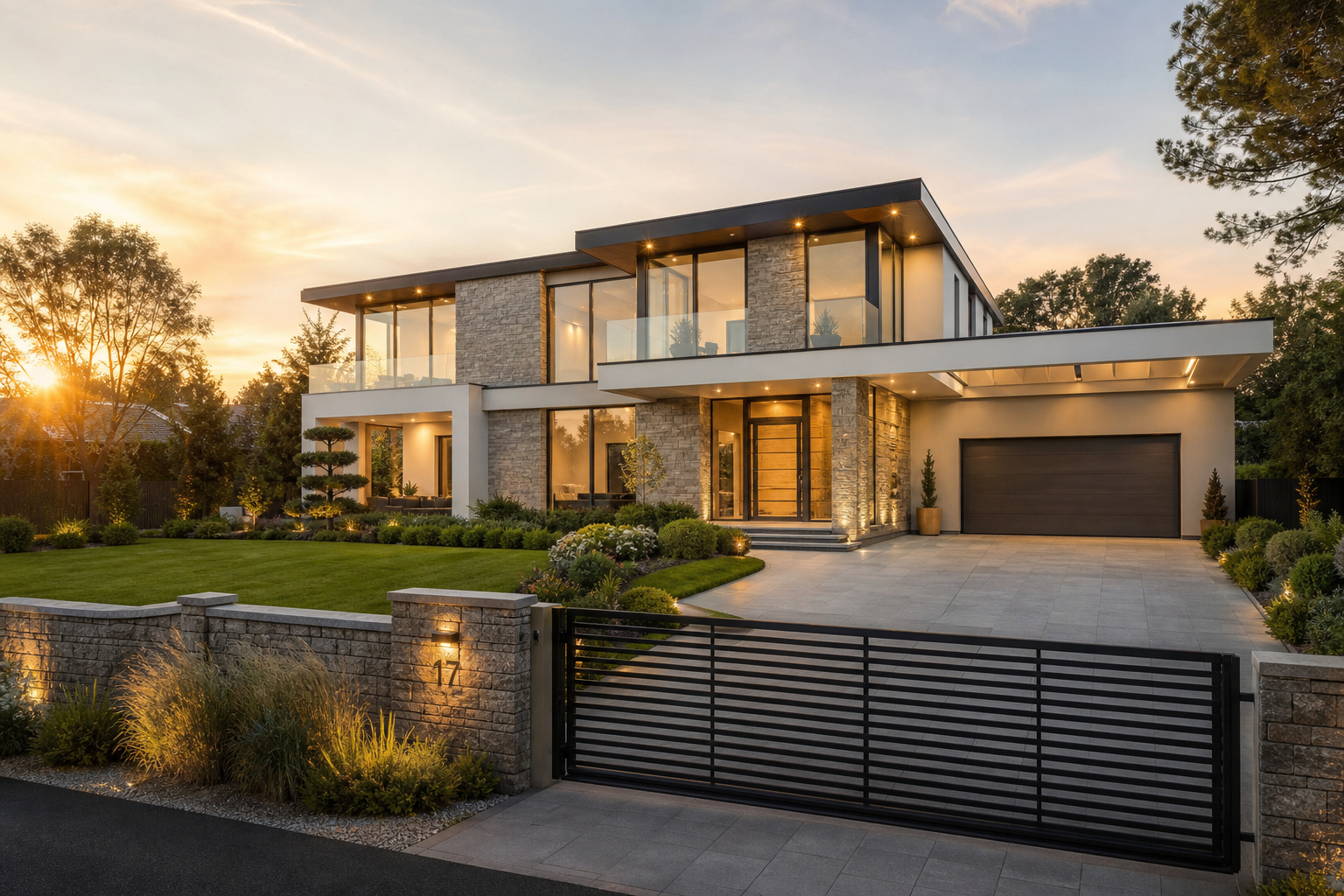
A 6-8 room house with basement or workshop, extensive garden, 3 gates, and 2 pedestrian gates.
Installation scope:
| Function | Count |
|---|---|
| Grouped / high-inrush lighting circuits (Relay) | 20 |
| Lighting circuits via I/O + external DIN relay | 18 |
| Blinds / shutters | 15 units - 8 Relay modules (30 outputs; 2 blinds per module, 2 outputs free) |
| Heating zones | 12 - thermostatic heads on I/O outputs |
| Controlled sockets | 12 |
| 1-Wire temperature measurements | 12 |
| Gates and pedestrian gates | 5 (3 gates + 2 pedestrian) - I/O outputs |
| Garden irrigation | 8 zones - solenoid valves on I/O outputs |
| Wall switch keys | 40 I/O inputs |
| Analog sensors | 10 units: humidity in basement, workshop, and bathrooms; CO2 in bedrooms and study; water cistern level transducer (4-20 mA); water flow sensor (4-20 mA); anemometer and solar irradiance sensor (0-10 V) |
The 18 additional lighting circuits here are implemented via I/O outputs with inexpensive external DIN-rail relays. Each I/O output drives one relay that switches a 230 V circuit. This is cost-effective wherever the number of independent circuits matters and direct high-current switching with measurement is not required.
Module configuration:
| Module | Qty | Cost |
|---|---|---|
| Voldeno Hub | 1 | 1,299 PLN |
| I/O Module | 7 | 6,293 PLN |
| Relay Module | 16 | 9,584 PLN |
| 1-Wire Module | 1 | 599 PLN |
| Analog Input Module | 2 | 1,198 PLN |
| Total | 27 modules | 18,973 PLN |
Split of 16 Relay modules: 5 for 20 lighting circuits, 8 for 15 blinds (each module drives 2 blinds: 30 outputs, 2 free in the last module), 3 for 12 controlled sockets.
Seven I/O modules (56 inputs and 56 outputs) handle: inputs from 40 wall switches, outputs to 18 low-current lighting circuits (via external DIN relays), 12 heating zones, 5 gates/pedestrian gates, and 8 irrigation zones. 16 inputs and 13 outputs remain free. Free outputs can be allocated to additional heating zones, irrigation zones, or further lighting circuits via external relays.
Two Analog Input modules provide 8 voltage and 8 current inputs in total. The first module takes humidity sensors in the basement, workshop, and bathrooms, and CO2 sensors in bedrooms and the study. The second handles a liquid-level transducer on the rainwater cistern (4-20 mA), a water flow sensor on the supply line (4-20 mA), an anemometer from the weather station (0-10 V) for blind retraction in high wind, and a solar irradiance sensor (0-10 V) for shading automation.
# Comparison
| Apartment ~100 m² | House ~120 m² | Large house ~200 m²+ | |
|---|---|---|---|
| Modules on DIN rail | 9 | 15 | 27 |
| Voldeno hardware cost | 6,691 PLN | 10,585 PLN | 18,973 PLN |
| Lighting circuits total | 12 | 16 | 38 |
| Blinds / shutters | 4 | 8 | 15 |
| Heating zones | 4 | 6 | 12 |
| Garden irrigation | - | 4 zones | 8 zones |
| Gates and pedestrian gates | - | 3 | 5 |
| Controlled sockets | 4 | 6 | 12 |
| Analog sensors (0-10 V / 4-20 mA) | - | 4 | 10 |
# What is not included in these prices?
The figures above cover Voldeno hardware only (DIN-rail modules). Additional budget items to plan for:
- control and network cabling to modules
- electrician labour and enclosure installation
- temperature sensors (e.g. SEN1WT3)
- actuators: blind drives, zone valves, gate drives
- external DIN relays for lighting cost optimisation (large house variant)
Voldeno hardware typically represents 30-50% of the total installation cost. The remainder covers electrician labour, cabling, and (when using a system integrator) automation design and logic configuration in Voldeno Studio. That last item can be significant for complex installations with many zones and automations.
All prices in this article include VAT at the standard rate applicable in Poland. If your country applies a reduced VAT rate to installation services in private residential buildings, the total cost through an installer may be lower than purchasing hardware and services separately. Check the rules in your jurisdiction.
If you have the technical background, you can handle the design and configuration yourself: an electrician takes care of the distribution board work, while you build the control logic (scenes, schedules, conditions) in Voldeno Studio. The tool is free and available at Downloads.
# Expanding without renovation
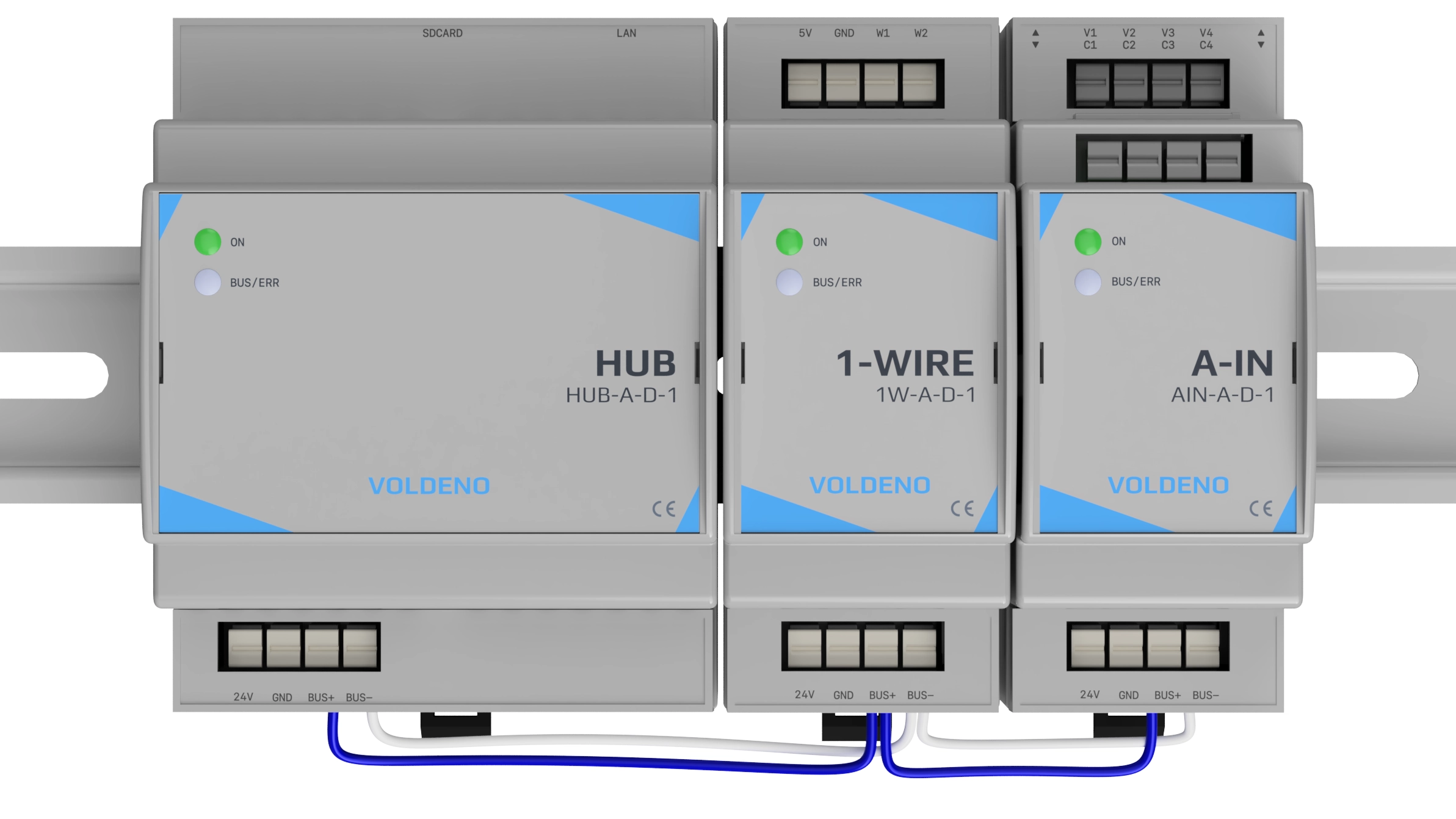
Every new Voldeno module mounts on the DIN rail and connects to the Voldeno Bus, with no change to the central unit and no work in the walls. If you leave spare space in the distribution board during the electrical design phase and run spare cabling to future points (switches, sensors, actuators), expansion later comes down to sliding in a new module and connecting ready-made cables.
A common practice is to run the Voldeno Bus to a separate enclosure (garage, utility room, or garden) at build time, even if no automation is planned there immediately. When the time comes for garden lighting, irrigation, or gate automation, the bus is already in place and the right modules can be installed in that secondary enclosure.
More on planning an installation from electrical design through commissioning: Bus topology and wiring
Planning a smart home? Leave your email
We will help match modules to your project or point you to a certified installer.