
# What is a smart home and how does it work?
A smart home is a standard electrical installation extended with an automation layer: electronic modules mounted in a distribution board that control lighting, heating, blinds, gates, and sockets according to rules defined in software. The key difference from a conventional installation is that each output's function is stored in a configuration project, not hard-coded in the wiring.
# What is a smart home?
A smart home is a building where selected electrical circuits are controlled programmatically, not only manually. Instead of a conventional switch that mechanically opens or closes a circuit, the installation contains a module in the distribution board with digital inputs (buttons, sensors) and outputs (relays, low-current outputs). Inputs capture events; outputs react to them according to defined rules.
A smart home is not a collection of independent Wi-Fi devices with multiple apps. It is a unified platform: one configuration project covering lighting, blinds, heating, and gates simultaneously, with the ability to build automations across all of them.
# How does a smart home work?
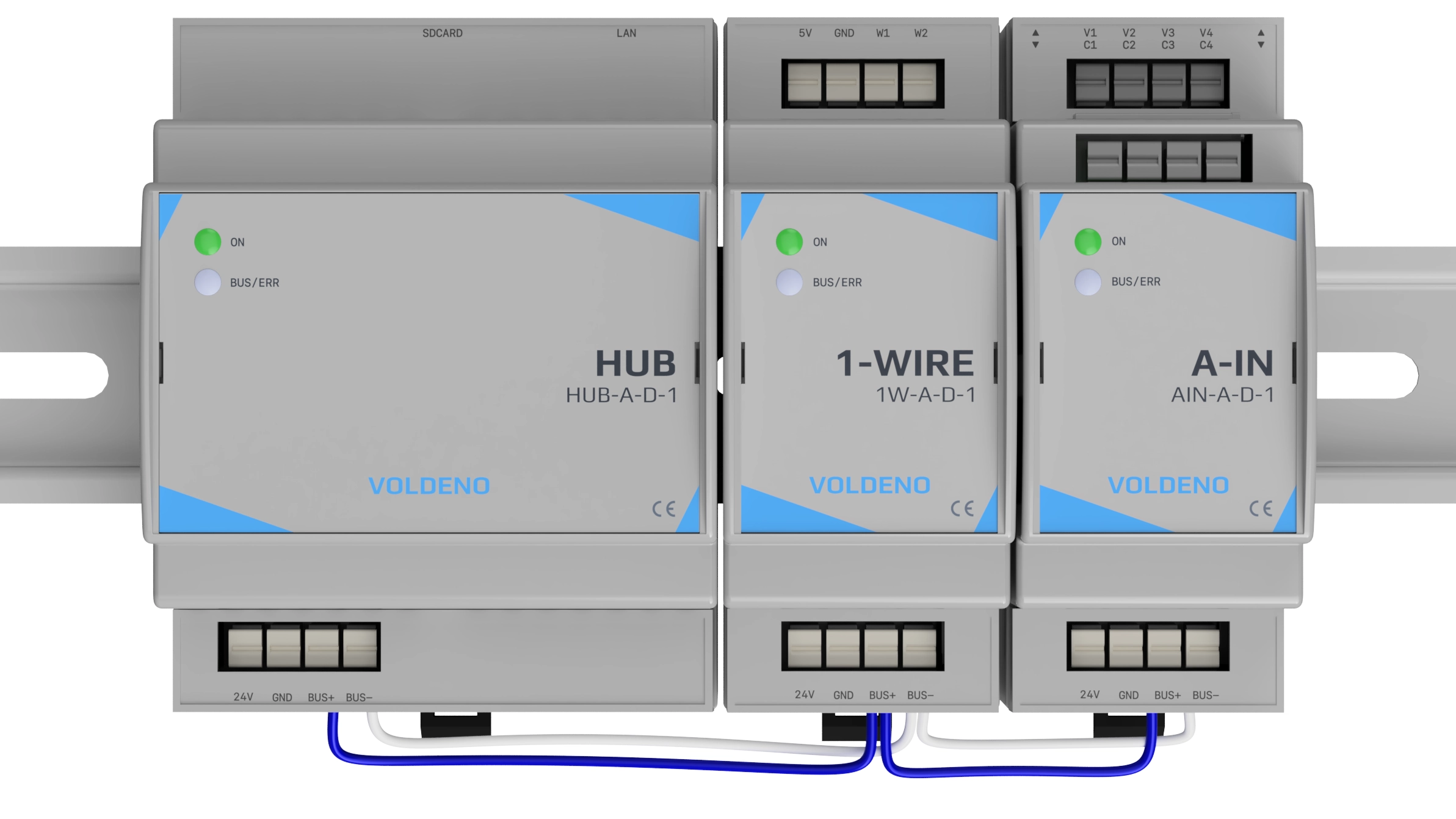
Physically: modules on a DIN rail inside a distribution board are connected by a wired control bus. Through the bus, modules exchange input and output states and execute programmed logic. In Voldeno, the control bus is Voldeno Bus based on CAN-FD, powered at 24 V DC. It runs via a twisted-pair or YnTKSY control cable between modules in the enclosure and between distribution boards throughout the building.
From the user's side: you press a wall switch, which is a digital input of a module. The module processes the event according to logic blocks and activates the appropriate outputs - a group of lighting circuits, a blind actuator, or a zone valve.
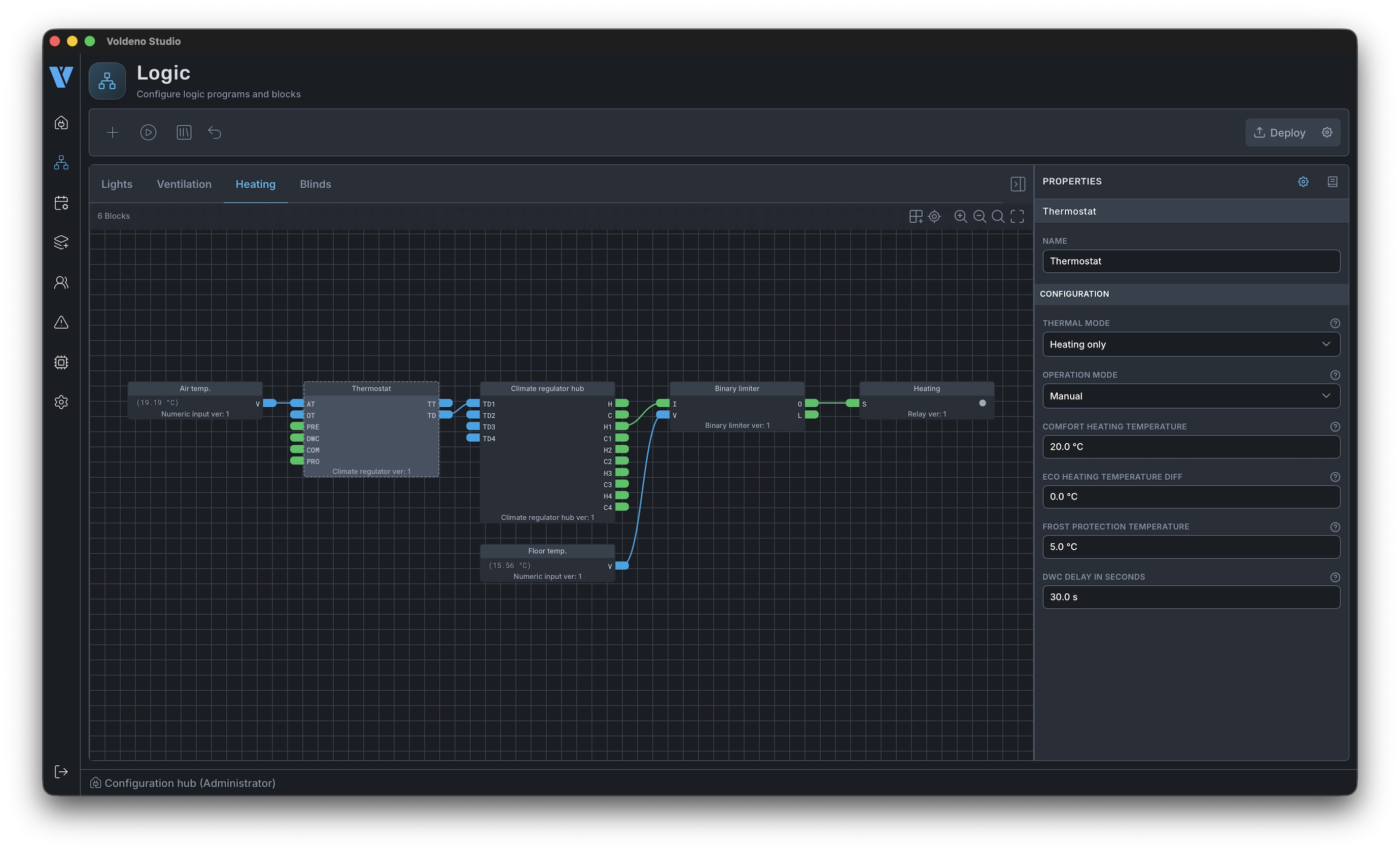
From the installer's side: configuration is done in Voldeno Studio on a PC. Input/output mapping, scenes, schedules, and conditions are defined with a drag-and-drop interface or, for complex scenarios, in the Volang language. The finished project is uploaded to the Hub and runs locally without a cloud connection.
# What can you control in a smart home?
The scope is set by which circuits are available from the distribution board and what input signals are present. A typical Voldeno installation covers:
- Lighting: group circuits via the Relay module (230 V), low-current points via I/O, scenes, and schedules
- Blinds and shutters: electric drives controlled up/down, automatic closing on high wind (analog sensor input)
- Heating: thermostatic actuators on zone valves via I/O outputs, 1-Wire temperature sensors per zone, scheduling
- Gates and doors: garage and sliding gate drives, open/closed state feedback
- Sockets: switching loads off, current monitoring on every Relay output channel
- Garden irrigation: zone solenoid valves with schedule and rain sensor condition
- Measurement: humidity, CO2, liquid level, and flow sensors on Analog Input (0-10 V and 4-20 mA) inputs
# How does a smart home differ from a conventional installation?
In a conventional installation, switch A controls lamp B, switch C controls lamp D. Changing that relationship requires changing the wiring.
In an automation installation, wiring follows a star topology: each light point and each load has its own cable running back to the distribution board. Every output's function is set in software. A single wall switch can control one lamp, a multi-zone scene, or trigger the underfloor heating - without touching a single cable. Changing a function means editing the project in Studio.
Star-topology wiring is the prerequisite for a full automation scope. If such an installation already exists, modules can be added to the distribution board without touching the existing wiring.
# Wired or wireless smart home?
Wireless systems (Wi-Fi, Zigbee, Z-Wave) require no new control cables and are quicker to install, especially in retrofits. The trade-off is radio reliability in buildings with dense device networks and reinforced concrete walls.
Wired systems require planning cable routes and space in the distribution board. In new construction or a full renovation, that is a one-time investment that delivers full reliability and predictable response times for the life of the installation.
A detailed comparison of both approaches and selection criteria is in How to choose a smart home system?.
# When does it make sense to install a smart home?
New construction is the ideal time: star-topology wiring from the start, control bus routes planned alongside the electrical design, enclosure space sized from day one.
Full renovation with wiring replacement offers the same opportunities. The key requirement: separate cables from the distribution board to every light point and load.
Existing installation without renovation: automation scope is limited to circuits already accessible from the board. The Hub's HTTP and TCP integrations can connect network-enabled devices (boiler controller, alarm panel, PV inverter) without new cabling.
# What does a smart home actually automate?
A few typical scenarios built in Voldeno Studio:
- "Leaving home" scene: all lights off, blinds closed, heating zones lowered, controlled sockets switched off
- "Goodnight" scene: gradual lighting fade, blinds closed, TV and audio sockets off
- Automatic irrigation: schedule with "no rain in the past 24 hours" condition via analog rain sensor input
- Energy monitoring: every Relay output measures current; live load overview in Voldeno Mobile
- Alarm integration: lights on when a motion sensor triggers the alarm panel via TCP
- Zone heating: each zone with its own schedule and 1-Wire sensor, automatic off when a window is open
# Questions and answers
What is a smart home? A smart home is a building with a building automation installation: modules in the distribution board control lighting, heating, blinds, and sockets according to programmed rules. The installation is configured in software; daily control happens through physical switches or a mobile app.
Does a smart home need a permanent internet connection? No, if the system runs logic locally. In Voldeno, automations run on the Hub and in the I/O modules without internet access. An internet connection is only required for remote access from outside the building.
Is a smart home secure? All communication in Voldeno is TLS-encrypted. Data stored in module flash memory is encrypted. The system runs locally; no installation data is permanently stored in the manufacturer's cloud. Details: Privacy policy.
Does a smart home need a server or a computer running 24/7? No. The Hub is a DIN rail module powered from the 24 V DC bus. Automation logic runs in the modules themselves - no separate server or NAS required.
Can a smart home be installed in an existing flat without renovation? To a limited extent. Circuits accessible from the distribution board can be automated without touching the wiring. Full independent control of individual light points requires star-topology wiring.
How much does a smart home cost? Hardware starts at around 6,700 PLN for a ~100 m² flat (9 modules) and ~10,600 PLN for a ~120 m² house with a garden (15 modules). Detailed module breakdowns are in How much does a smart home cost?.
What is the Voldeno Hub? The Hub is the system's central node, mounted on a DIN rail in the distribution board. It provides Ethernet connectivity, local project storage, remote access, and network integrations via HTTP, TCP, and UDP. Full description: Hub.
# Next step
To compare wired and wireless architectures or work through a system selection checklist, go to: How to choose a smart home system?. For hardware costs broken down by building size, see: How much does a smart home cost?.
Planning a smart home? Leave your email
We will help match modules to your project or point you to a certified installer.