
Smart home relay explained: how a smart relay works, what current measurement adds and how to cut sockets in Away mode. Examples with the RELAY module.
# Smart home relay: what it is and what current measurement is for
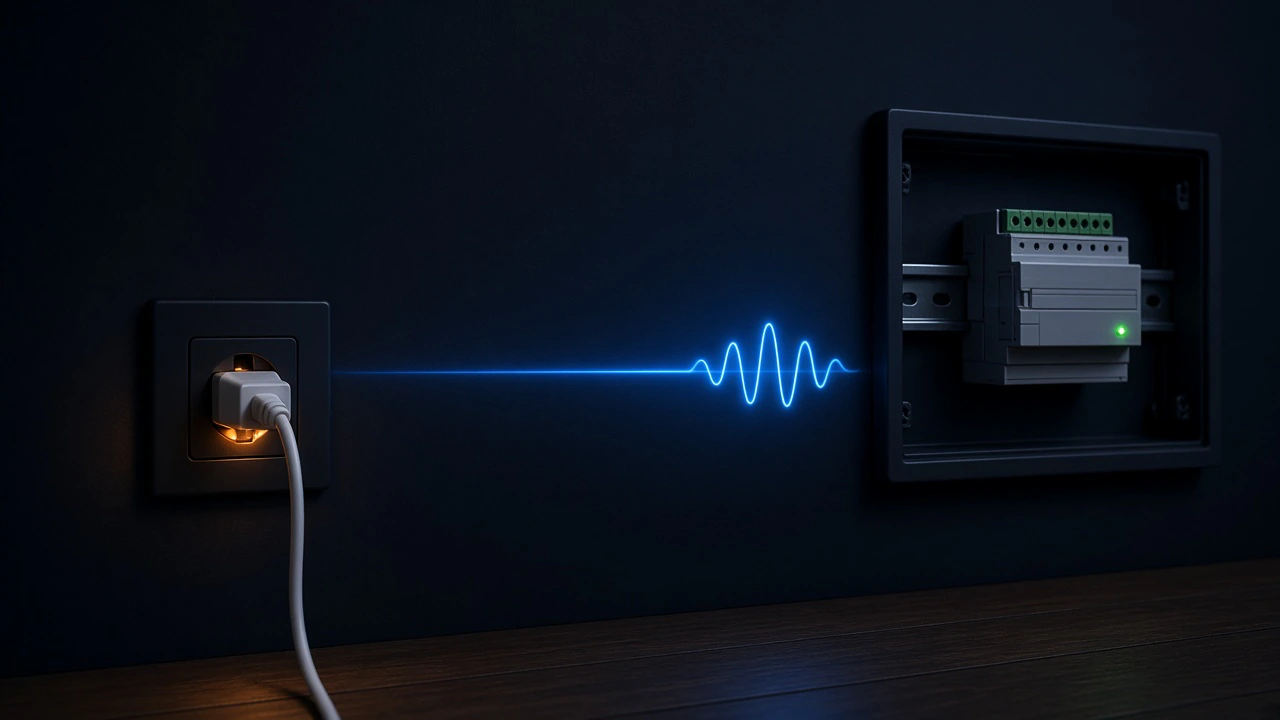
A smart home relay in the distribution board does two things: it switches a circuit on and off on command from the logic, and if it has a current sensor, it also sees what that circuit is doing. The second part changes more than it seems. A module that knows the induction hob is running can start the extractor hood. A module that knows the state of the house can cut the sockets when everyone has left.
Below we explain what a smart relay is, where it is installed and how to use current measurement. At the end we show it on the Voldeno RELAY module, including its limits.
# What is a smart home relay?
A smart home relay is a relay controlled by an automation system instead of a manual switch. The home logic closes or opens its contact, and that contact powers a circuit: lighting, sockets, a heating element or a pump. Versions with current measurement also report how much current the load draws.
A plain electromechanical relay has a coil and a contact. Current in the coil creates a magnetic field that pulls in an armature and closes the load circuit. A smart home relay does the same, but the command comes from the system logic: a button, a schedule, a sensor or the app. The contact design and the arcing problem are covered in our post on zero-crossing switching.
# Plug, wall box or distribution board?
Smart relays come in three forms. They differ in where they are installed, and that decides what they can switch and measure.
| Smart plug | Relay in a wall box | DIN rail module | |
|---|---|---|---|
| Location | between socket and appliance | behind a switch or socket | in the distribution board |
| What it switches | one appliance | one lighting circuit or a socket | whole circuits, usually up to 16 A |
| Current measurement | in some models | in some models | depends on the module (RELAY: every channel) |
| Connectivity | usually Wi-Fi or radio, often with a cloud account | usually radio | wired (here: Voldeno Bus) |
| Installation | the user | an electrician, in a tight box | an electrician, in the board |
| Expansion | each device separately | each box separately | another channel or module |
A plug works when you want to measure a single appliance in a house that is already finished. In a new build or a full renovation it is more practical to put the relays in one place: all circuits are visible in one board, there are no batteries or radio range to watch, and replacing a module does not mean chasing walls.
# What does current measurement in a relay give you?
A current sensor at the relay contact measures amperage. Knowing the mains voltage (about 230 V), you can estimate power from it: current multiplied by voltage gives apparent power in volt-amperes. For resistive loads such as heating elements, irons and kettles, the result is close to real power in watts. For motors and switch-mode power supplies it will be higher than real power.
A few typical values:
| Appliance | Typical power | Current at 230 V |
|---|---|---|
| Electric kettle | 2000 W | approx. 8.7 A |
| Iron | 2400 W | approx. 10.4 A |
| Dishwasher or washing machine while heating | 2000 W | approx. 8.7 A |
| Electric heater | 3000 W | approx. 13 A |
| Three-phase hob, 7.4 kW | 7400 W total | approx. 11 A per phase |
The most important limit: the module only sees what flows through its contacts. The measurement therefore covers a circuit, not a single socket in a room. If ten sockets hang on one circuit, the reading is the sum of everything plugged into them.
# What can you use current measurement for?
# Energy use per appliance
When a large appliance has its own circuit (washing machine, dishwasher, boiler, air conditioner, garage sockets), the current from one channel tells you when it runs and how much it draws. After a few weeks you can see that the boiler heats every night and the dishwasher starts during the most expensive tariff hours. That is a good starting point for moving the work of appliances to a cheaper period or to the hours of surplus from solar panels.
Current readings from the RELAY module are available in Voldeno Studio and Voldeno Mobile. This is a measurement for analysis and control, not a billing meter. Billing tenants or sub-metering requires an energy meter with a suitable accuracy class.
# An extractor hood that starts by itself
A hob starts drawing current before the kitchen fills with steam. The logic can react: when the hob circuit current goes above a threshold, the hood starts, and when it drops below a second threshold, the hood runs for a few more minutes and switches off.
In Voldeno Studio this takes three blocks: a hysteresis block (a switch-on threshold and a lower switch-off threshold), an off-delay block and the relay output for the hood. Hysteresis matters here because hobs on a low setting cycle on and off, and without it the hood would flicker.
There are two caveats. First, a relay can only start a hood that starts by itself when power is applied. Hoods operated with buttons on the housing need a different control input, for example a dry contact from the I/O module. Second, the current has to flow through a module channel. A three-phase 7.4 kW hob draws about 11 A per phase, so it fits the 16 A limit, but it needs a separate channel for each phase and a design decision with the electrician on whether to route it through the module at all. A normally open (NO) contact also means the circuit is open when the module has no power.
# End of a work cycle
Washing machines, dishwashers and dryers finish without sending a signal. Current dropping below a threshold for a few minutes is still a good marker of the end of a cycle. The logic can then start a fan in the utility room, change a scene or switch off the circuit so the appliance does not draw standby power.
# Fault detection
The relay knows the state it commanded and the current that actually flows. If the channel is on and the current is zero, the load is not working: a burnt boiler element, a disconnected circulation pump, a broken circuit. In the other direction, a pump that runs for hours when it should not is a reason to check the installation. Both cases can be written in the logic as a simple condition.
# The forgotten iron and Away mode
The simplest protection against a forgotten appliance does not need current thresholds. When the house switches to Away mode, the logic switches off the socket circuit channels. An iron left on the board has no voltage, whether or not anyone remembered it.
Away mode is an ordinary state in the logic. It can be set by holding a button at the door, a schedule, presence sensors or the app, and a block monitoring the operation mode passes it to the RELAY module outputs. When you return, the same button or a mode change restores power.
Current measurement adds a second layer. A "Leaving" scene can check whether any socket circuit draws current above a threshold and show it in the app before you close the door. Cutting the power works even when nobody looks at that message.
It is worth splitting the socket circuits at the design stage. The fridge, freezer, router, alarm panel and the basement pump should have a circuit that stays powered in Away mode. Sockets in rooms, on the kitchen worktop and in the dressing room can be switched off.
# Voldeno RELAY: what it measures and switches
Voldeno RELAY is a DIN rail module with four independent relay outputs. Each channel switches up to 16 A at 250 V AC (category AC1) and has its own current sensor, so the module measures four circuits separately.
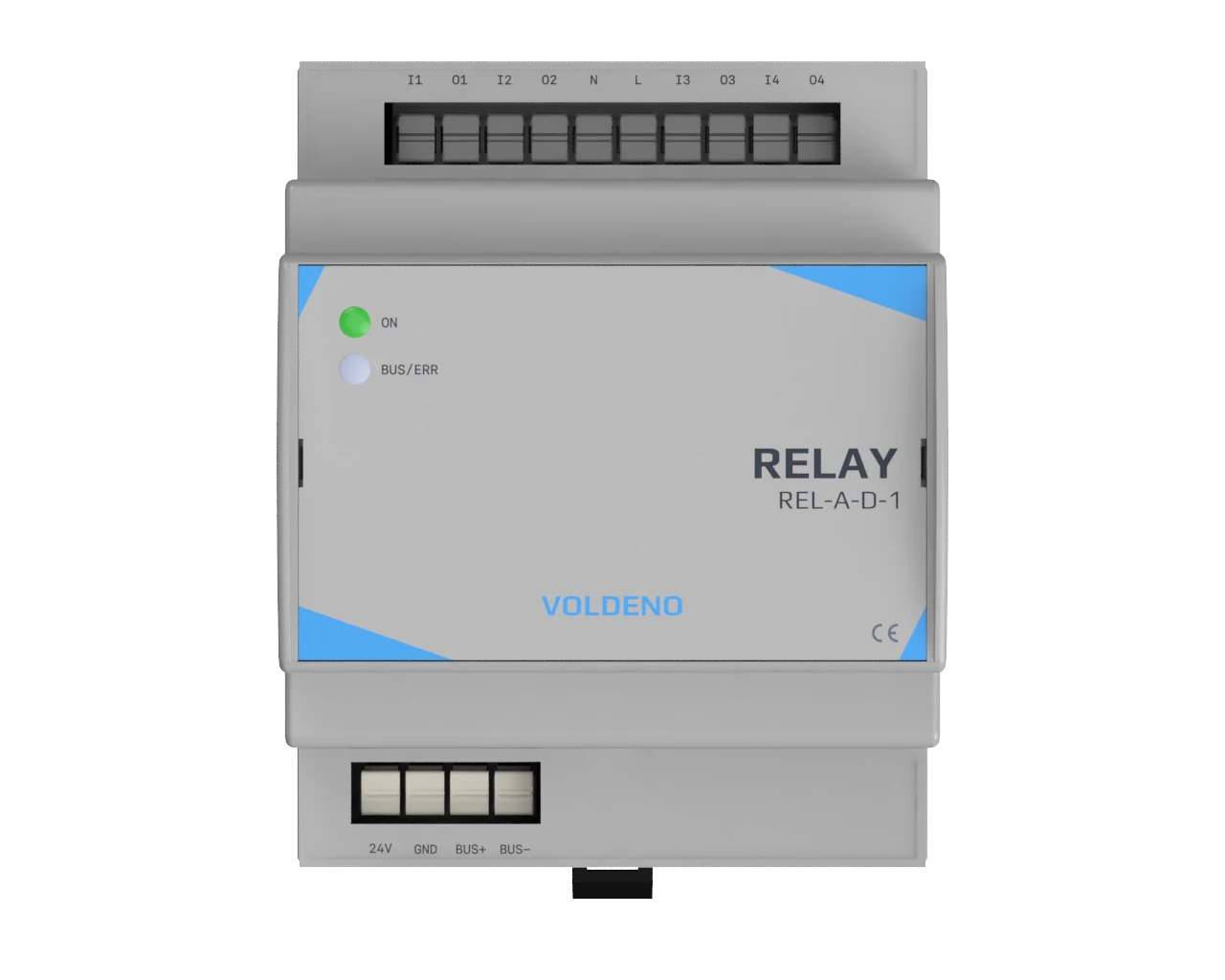
| Parameter | Value |
|---|---|
| Number of channels | 4, NO contacts |
| Resistive load (AC1) | 16 A / 250 V AC per channel |
| Motor load (AC3) | up to 750 W / 240 V AC |
| Inductive loads (AC15) | 1.5 A / 240 V AC |
| Current measurement | separate sensor on every channel |
| Protection | module temperature sensor, reverse polarity protection on the supply |
| Power and data | 24 V DC and CAN-FD over Voldeno Bus |
| Mounting | 35 mm DIN rail, 4 module widths |
| Price | PLN 599 gross (incl. VAT) |
The module needs a Hub in the same installation. The logic runs locally, so the hood, the socket cut-off in Away mode and the current thresholds do not depend on the internet. For AC loads the channels switch at zero voltage, which limits inrush current and contact wear. Wiring details are in the RELAY module wiring guide.
What does RELAY not do? It does not replace overcurrent protection in the board: every circuit needs its own breaker. It is not an energy meter and does not report power factor. It cannot tell sockets on one circuit apart. It also has no digital inputs, so buttons and sensors connect to the I/O module, and RELAY carries out what the logic decides.
# How to plan circuits for relays with current measurement
- List the appliances whose consumption you want to know or that should trigger other devices (hob, boiler, washing machine, air conditioner, electric heating). Each gets its own circuit.
- Split the remaining sockets into circuits that stay powered and circuits that are switched off in Away mode.
- Count channels: one circuit is one channel, one RELAY module is four channels.
- Check currents and load categories. Heating elements fit AC1, motors and pumps need AC3 or AC15.
- Add spare channels. In the guide on smart home design mistakes we recommend 30-50%.
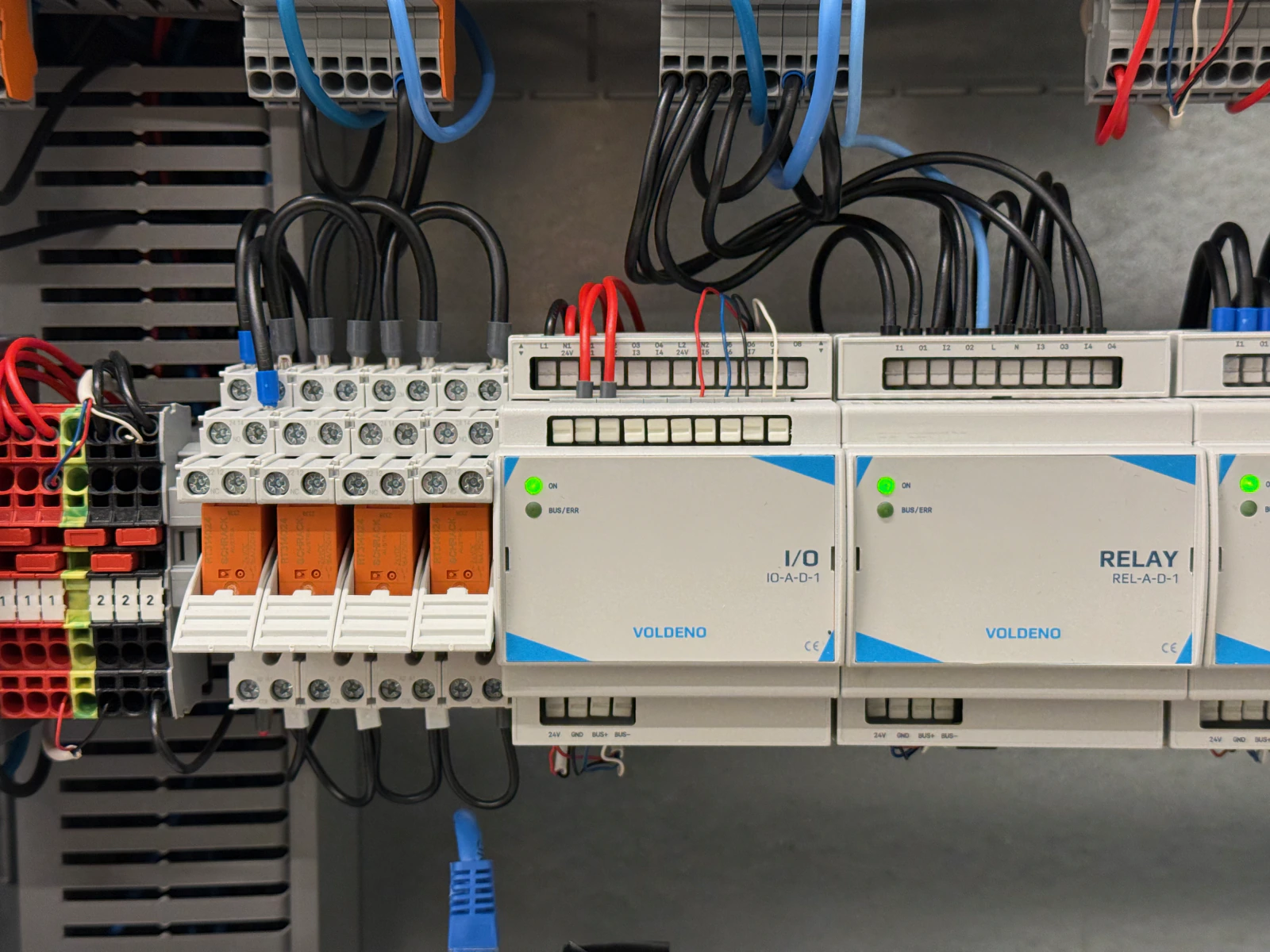
For scale: the Modern barn installation runs nine RELAY modules, which is 36 channels, next to seven I/O modules and one Hub. Module lists for an apartment and houses of different sizes are in the guide how much does a smart home cost.
# FAQ
# How is a smart home relay different from an ordinary relay?
An ordinary relay reacts to a signal from one source, such as a switch or a thermostat, and knows nothing about the rest of the installation. A smart home relay is part of a system: it gets commands from the logic, can depend on the house mode, schedules and other sensors, and in the version with current measurement it reports the load.
# Can current measurement in a relay replace an energy meter?
No. The module's current lets you estimate power, see trends and trigger actions, but it has no meter accuracy class and ignores power factor. Energy cost between units is settled with energy meters, which can connect to the I/O module through the S0 pulse output.
# Will a relay switch off an iron that was left on?
It switches off the socket circuit the iron is connected to, for example when the house goes into Away mode or when a set time of high current draw is exceeded. The iron itself does not know it was switched off, but it has no voltage and does not heat. It will not work only if the socket is on a circuit excluded from this mechanism, which is why the circuit split is worth planning early.
# Is the measurement separate for each socket?
No. The module measures the current of the circuit that passes through its channel. A single socket is measured with a smart plug or by giving it its own circuit to the board, which mainly makes sense for large appliances.
# Does it work without the internet?
Yes. The logic runs locally on the Hub and modules, so current thresholds, the hood and Away mode work without network access. The internet is only needed for remote access from outside the house.
# Are relays in the board better than smart plugs?
In a new house, usually yes, because one module serves four circuits and needs no batteries or radio range. In a finished apartment with no access to the board, a smart plug is quicker to set up. The two methods can be combined.
# Summary
A smart home relay is most useful when, besides switching a circuit, it tells you about its load. Current measurement on each channel lets you start a hood when the hob runs, detect the end of a washing cycle or a pump fault, and Away mode cuts power to the sockets without asking whether anyone switched off the iron.
If you are planning an installation and want to check which circuits are worth routing through RELAY modules, book a free consultation. You can also download Voldeno Studio and test logic with current thresholds in the simulation.